
Plan your Homecoming 🎉
Will we see you on campus October 16–18? Cheer on the Big Red, take in the drone and laser light show, and get ready for an amazing Homecoming weekend.
Get tickets
Hello Cornellians,
I’m Andy Willner ’92, founder and managing director of CAEDENCE. Our firm develops & coaches technical and business leaders and accelerates companies’ results by leading operational excellence projects, and resolving pressing manufacturing, product development, and quality systems issues. I wanted to share with you a foundational career skill that will really set you apart: SMART1 goals.
Picture this: you’ve just started a new job, or maybe you're trying to get your own company off the ground. You’re excited to launch your career on the right foot, but you’re starting to realize it might not be as straightforward as you’d imagined. You’ve noticed some important differences between the way professionals work and the way students do:
Students: Encouraged to explore what is most interesting
Professionals: Required to work on what is most important
Students: High, but (just) manageable
Professionals: Infinite—there are always more things that could be improved
Students: "The effort I put in is the strongest correlate to my results."
Professionals: "Influencing others can often make the biggest difference in my results."
Students: Tasks are doled out sequentially and assumptions are provided
Professionals: Need to define your own sequence and make your own assumptions
Students: Understanding is paramount; focus is on learning the concepts
Professionals: Results are paramount; focus is on delivering outcomes on time
Students: Professors' requirements are fixed and clearly documented up-front
Professionals: Managers' expectations may be unclear, unspoken, and changeable
As a high-achieving Cornellian, you’re probably noticing that to succeed at work, you’ll need to think in a new way. You’ll need a system to address these differences. The SMART framework is a foundation for that system.
At work, consistently delivering important results on important things distinguishes successful careers across industries. This may sound simple, but it can be tricky to achieve. Hard work, cleverness, and attention to detail aren’t enough. Having maximum impact starts with determining the things that matter most; it’s sustained by making a habit of working on those things every day.
You can’t always determine what matters most on your own. The process requires collaborating with your manager (or co-founder & investors). Early in your career, they’ll likely tell you what’s important. With time, you’ll be expected to make suggestions and shape your assignments, having carefully considered your organization’s priorities, budget, market circumstances, and other factors. Since your manager plays a key role in evaluating your job performance, it’s crucial to minimize misunderstandings and ensure you are “on the same page.” SMART provides a framework for clarifying and documenting expectations.
SMART is an acronym standing for Specific, Measurable, Achievable yet Aggressive, Relevant, and Timebound & Tracked.
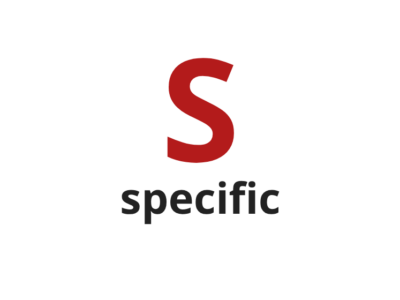
Specific means that the goal must be clear.
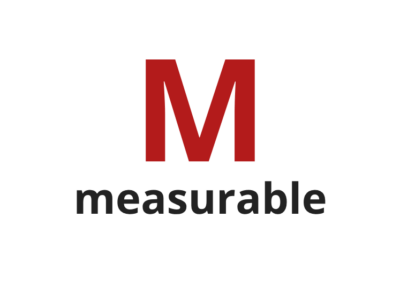
Measurable means that the goal is quantified.
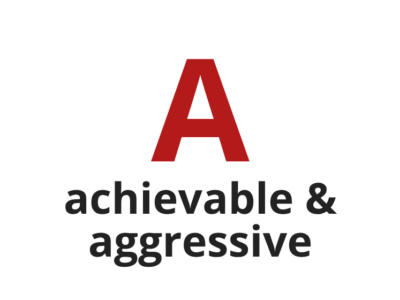
Achievable yet aggressive is about the scope of the goal. Scope too small and your results will be trivial, scope too big and you'll fail to deliver.
Relevant refers to the rationale for the goal, its importance.
Time-bound and tracked requires both a deadline to complete the project, and a schedule someone is paying attention to (ensuring steady progress is happening and reacting if it isn't).
SCENARIO A
Your manager tells you that your priority is to “save money.” After talking with your colleagues, you identify two potential money-saving projects.
Take a moment to think about which project you would pursue, then click through the questions below:
SCENARIO B
Now, imagine you ask your manager for more details. They tell you that your priority is to “save $100,000 by the end of this calendar year so the company can buy necessary equipment.” Your project options are the same:
Take a moment to think about which project you would pursue, then click through the questions below:
The project options were the same across scenarios, but the recommendation and follow-up changed. Why? The goal’s structure and phrasing made all the difference. Scenario A’s goal was ambiguous; Scenario B’s goal was expressed in SMART format.
The SMART framework addresses each of the differences between how students and professionals manage their work:
SMART defines “success” in a clear, quantified way, ensuring that you and your team know exactly what the required outcome looks like.
SMART facilitates planning, prompting you to create sub-goals and milestones on the way to achieving the main goal. As your project proceeds, compare your progress against the SMART goal to check if you’re on track (and then take appropriate action as needed).
SMART provides a structure for decision-making. Virtually every decision in business, academia, government, or life in general is about balancing the costs (resources) to minimize the uncertainty (risk) of achieving a desired outcome (reward). The SMART approach encourages thoughtful consideration of these trade-offs.
SMART influences team behavior by ensuring everyone knows exactly what’s expected and how it will be measured. A written reference "keeps you honest" and forms a sort of contract with your manager.
SMART helps prevent scope creep2 by providing a documented baseline, making new requests apparent.
SMART goals are most effective when they’re established in collaboration with the relevant stakeholders (people who care about the outcome like managers and customers), and contributors to the objective’s successful delivery (like team members and suppliers).
Use the script below to evaluate any activity or assignment that lands on your plate. Each item corresponds to one or more of the SMART categories, as indicated.
| Category | Questions to Consider |
|---|---|
| Definition | What exactly needs to be done? (What is the deliverable?) [S, A] |
| How will we know when it’s complete? (Definition of success, metric?) [M] | |
| Why is this needed; what would be the consequences if it weren’t done? (Big picture?) [R] | |
| Timing | When is it desired to have this completed? (Stretch goal?) [T] |
| When is it necessary to have this completed and what happens if it’s late? (Deadline? Relevance?) [T, R] | |
| Does it require any new equipment or learning? (Resources? Potential delay?) [A, T] | |
| When is it realistic for it to be completed [assuming Murphy’s Law3 applies]? (Feasible?) [A, T] | |
| Prioritization | Where does this fit in among all the things I have already committed to deliver? [T] |
| If anything that was already on my list will be impacted, have I confirmed that the relevant stakeholders will accept the delay? [R, T] |
Developing the discipline to apply SMART to every goal will influence your career trajectory by:
Transitioning into “the real world” as an early career professional can be hard. With SMART goals, you can deliver consistent results on things that matter AND set yourself up for success both now and in the future.
Sources:
Want to learn a complementary tool for managing your time and activities in support of your SMART goals? Want to understand how multitasking destroys productivity? Want help developing a product, managing a project or team, or optimizing an operation or business? Want to level-up the performance of your team? Let’s talk!
Follow Andy on LinkedIn | CAEDENCE’s Website | Follow CAEDENCE on LinkedIn
Andy Willner graduated from Cornell, Binghamton, and NTU. He spent his career developing new products and engineering talent at Pratt & Whitney, Texas Instruments, and Sensata Technologies. In 2021, he co-founded CAEDENCE Consulting LLC where his team leads issue resolution & prevention in product development, manufacturing operations, and business processes. He is a sought-after mentor in CAEDENCE’s leadership and professional development coaching programs. Andy is a registered professional engineer and holds 8 patents on electromechanical devices and systems. He has delivered professional skills talks at Cornell, Johns Hopkins, UVM, Binghamton, IEEE, SAE, ASQ, and other academic and professional organizations. You can view his recent talks for free on time management and resume optimization on Binghamton’s Alumni Learning Network. Andy is a member of the Cornell Technology Business Network and you can connect with him on CUeLinks.

Will we see you on campus October 16–18? Cheer on the Big Red, take in the drone and laser light show, and get ready for an amazing Homecoming weekend.
Get tickets Division of Alumni Affairs and Development
Ithaca, NY
Division of Alumni Affairs and Development
Ithaca, NY