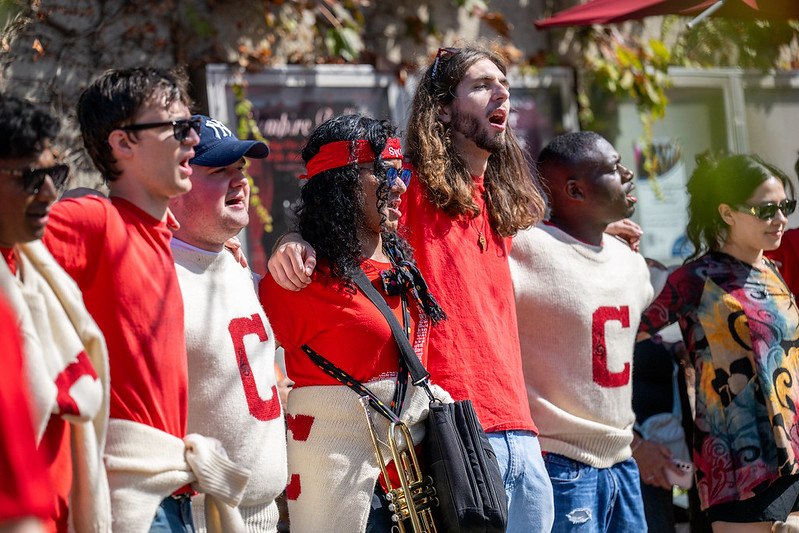
The Robert S. Harrison ’76 Recent Alumni Volunteer Award honors recent alumni who have made an impact on the Cornell community—and beyond—in their first ten years after graduation. The award was launched in 2023 to recognize the next generation of Cornell leaders.
The 2026 winners are Maciej Filip Bukowski LLM ’17; Dustin Liu ’19; Abby Macaluso ’20; Andrew Massaro DVM ’15; and Arpit Sheth ’17, MEng ’18. These five recent alumni leaders will be honored at Cornell’s first-ever Volunteer Summit in October.
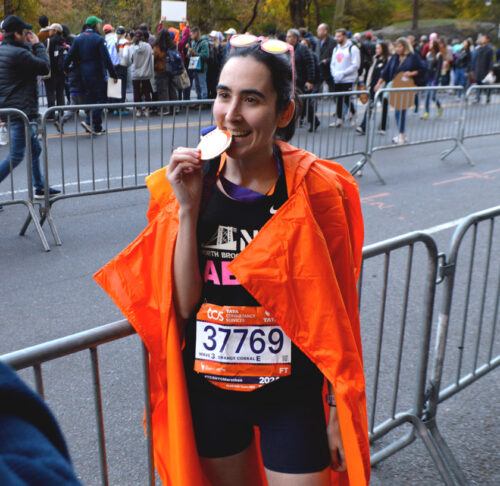
Abby Macaluso ’20 celebrates after completing the NYC Marathon in 2024.
Winners were selected by a committee of fellow alumni leaders, university trustees, and staff. Dillon Sumanthiran ’20, who serves as VP of the students and young alumni committee of CACO (Cornell Association of Class Officers), was part of the selection process. He says this year’s winners stood out for their initiative and ability to bring others together to create something new and worthwhile.
“A lot of people benefited from what they did for the university and around the world,” Dillon says. “None of them got any real benefit for themselves from organizing the programs that these folks created. So, it was a completely selfless initiative.”
“This award is a nice way for us to say thank you,” he adds.
Bob Harrison served his alma mater for nearly five decades, including as chair of the Cornell University Board of Trustees from 2012–2022. The Harrison Award honors his long-standing commitment to Cornell.
Meet the 2026 Harrison Award winners:
Maciej Filip Bukowski LLM ’17
“The world often feels ablaze today, and an education at a place like Cornell is a privilege that carries obligations alongside opportunities. The knowledge, judgment, and networks we gain there are not ends in themselves. Their greatest value lies in how we use them to strengthen the communities around us and to leave the world, however modestly, better than we found it. To me, that is the deeper purpose of staying involved with Cornell.
For young alumni, that engagement is also a source of meaning. It reminds us that a successful career is measured not only by personal accomplishment, but also by the opportunities we create for others. This impact does not have to be large to matter. Our Ukraine mentoring program reached only a handful of students, i.e., a drop in an ocean of needs. But if it helped the careers of any of them, then I deem our undertaking worth the effort it took.”
Maciej graduated from Cornell Law School’s LL.M. program in 2017. After clerking at the U.S. Court of International Trade and practicing international arbitration in Paris and Warsaw, he left private practice to pursue a PhD in international relations focused on the geoeconomics of clean energy. He subsequently served as chief expert at Poland’s Ministry of Climate and Environment and later as senior international analysis expert at the Polish Development Bank. Today, he leads the Energy and Resilience Program at the Casimir Pulaski Foundation, while serving as a non-resident fellow at CEPA and a research fellow with the Earth System Governance Project.
After graduation, Maciej founded the Cornell Club of Poland and currently serves as its president. In the aftermath of Russia’s invasion of Ukraine, he worked with club members to cofound the Cornell Mentors of Ukraine initiative. Club members recruited volunteer mentors, including senior public officials, leading analysts, and even a former minister of justice.
“Supporting Ukraine was about more than responding to an immediate crisis; it was about investing in the next generation of Ukrainian leaders and helping equip them with the knowledge, networks, and values that would be essential in rebuilding their country and strengthening its place within the European and transatlantic community,” Maciej says.
Dustin Liu ’19
“Giving back to Cornell has felt like a priority from my very first interaction with alumni. To this day, I’m still in touch with my alumni interviewer for the ILR School that I met when I was a senior in high school. I still keep in touch with alumni that I met through internship programs and shadowing programs. And, of course, I’m still deeply connected to members of the board through my time as a trustee. Because these people modeled for me how important their alumni mentorship and their alumni contributions were to my experience, it always felt like there was a responsibility for me to do this, too.
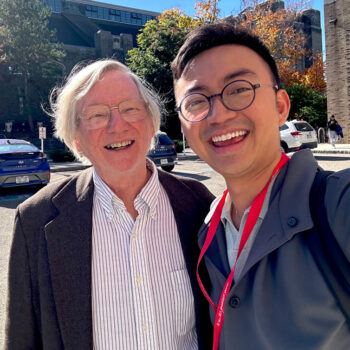
Dustin with Professor Emeritus Bill Sonnenstuhl
Alumni contributions allowed me to do research and go abroad. These experiences set me up for what I’ve done and what I’m going to do, so, it feels like a commitment that I wanted to make, too. I recently made a gift to the ILR school in honor of Bill Sonnenstuhl, who was a really important professor of mine. He always made me feel like it was an imperative to think about organizational culture and the people who are in organizations. And I feel like that completely changed my worldview.
I remember writing thank you notes to alumni donors when I was a student, and now I’m on the receiving end! It’s been very impactful for me to be able to reach out to current students and hear their stories.”
Dustin graduated in 2019 from the School of Industrial and Labor Relations. On campus, he served as the undergraduate student-elected trustee and as co-chair of the Senior Class Campaign. Since graduation, he has stayed involved as a board member of Cornell Pride, serving as a member at large of Cornell Mosaic and on the Cornell University Council. He continues to support and stay involved with the Center for Dialogue and Pluralism, the Einhorn Center, and Cayuga’s Watchers. In 2025, he funded the William J. Sonnenstuhl ILR WIDE Fellowship, which supports undergraduate research at the ILR School. He is currently a doctoral student of management and organizations at the University of Michigan.
Abigail Macaluso ’20
“I’m most proud of relaunching the Cornell Women’s Advocacy Network. When I found out about it during COVID, it had been largely inactive since before the pandemic. When I started in 2023, there were only a handful of us. Two of the other board members and I were friends who’d graduated from Cornell not long before. We’d never been in a volunteer leadership position before.
I’ve learned that, in this volunteer world, nothing happens if you don’t make it happen. During my tenure as chair, we were able to double the size of our board. We filled all of our open positions. We had the first in-person event in over three years. Now, we have in-person events almost every month. In March, we hit our first event where we had over 100 sign-ups.
Most people come to CWAN events if they’ve just moved to NYC, are looking for a new job, or want to hang out with their college friends for an evening. I am honored that I get to create a space for people to make new friends, advance their careers, and bond with each other. CWAN is one of the rare places where we get to bring generations of Cornell women together and have them learn from one another.”
Abigail studied Operations Research & Information Engineering at Cornell. Currently, she is an MBA candidate and health care fellow at the Wharton School. Previously, she worked at Memorial Sloan Kettering Cancer Center and Cityblock Health. Abigail is a volunteer for the Cornell Alumni Admissions Association Network, a member of the President’s Council of Cornell Women, and chair of the board of the Cornell Women’s Advocacy Network.
Andrew Massaro DVM ’15
“There’s a pretty special culture at the Veterinary College. Cornell was one of the first vet schools in the country to adopt a problem-based learning curriculum, and they’ve really mastered it. It actually starts from day one of your freshman year and continues throughout the entire curriculum. You’re not spending all of your time in a lecture hall or a lab. Instead, you’re in a small group, working through real life cases. This teaches you from very early on how to think like a doctor and how to approach a case and think through it, rather than just memorizing facts.
As an alum and someone who is out in practice in the real world, I feel I have so much to offer in the way of volunteer service to the college. Whether it’s providing insight to the faculty on how to best prepare the next generation of veterinarians, connecting with current students to answer their questions about life after graduation, or networking with fellow alumni to support each other through the various stages of our careers. This is at the heart of what we do as members of the College of Veterinary Medicine Alumni Association Executive Board. Plus, we meet on campus twice per year, and I LOVE having a reason to visit the beautiful town of Ithaca, as it’s one of my absolute favorite places!”
Andrew earned his DVM degree from the College of Veterinary Medicine in 2015. Following graduation, he completed a one-year internship at a large specialty hospital in New Jersey, then returned home to join his parents’ small animal general practice in Medford, NJ. Both his parents, James Massaro DVM ’86 and Janet Lipman DVM ’86, as well as his brother, Mark Massaro DVM ’19, also attended Cornell. Andrew has served as an at-large member of the College of Veterinary Medicine Alumni Association Executive Board since 2020, and treasurer of the board since 2024. He has also served as an alumni member of the admissions committee and as Reunion chair for the Class of 2015.
Arpit Sheth ’17, MEng ’18
“When you want to do the really hard, ambitious work, you can’t really do it alone. You need great teammates. You need great advisors, thought partners, investors. You need people to join you on the journey, and relationships really matter. Character, integrity, and trust really matter. A lot of the values that we teach at Cornell are what you see when you start interacting with alumni.
I think that taking advantage of volunteer opportunities through Cornell is a little life hack. For any ambitious young alumni who want to level up in their career, you can develop skills in parallel or on top of what you’re learning and developing in your day job. For me, it was a lot of the mentorship and leadership skills that are sometimes a little bit harder to come by early on in your career.
Maybe you’ll feel an itch to give back. And sometimes giving back could be as simple as responding to an email or a text or a LinkedIn message from another fellow alum who’s reaching out to you, and sometimes giving back could be much bigger than that.”
Arpit graduated from the College of Engineering in 2017, before joining Cornell Tech’s inaugural class on the Roosevelt Island NYC campus, where he earned an MEng in computer science in 2018. While there, he co-founded Crater, a generative AI video startup which won both the Cornell Venture Challenge and Cornell Tech Startup Awards. He then spent six years as a software engineering leader at WeWork, guiding tech teams through the company’s IPO, restructuring, and acquisition.
As president of the Cornell Tech Alumni Council, he helps connect 2,200+ alumni and 100+ startups to each other and the campus. Before Arpit, the alumni organization was “formless,” according to Matt Davis, former director of outreach and alumni engagement for Cornell Tech. Arpit reshaped the leadership structure for the alumni council, so that, “the network, resources, and mentorship that shaped my own founder journey would be extended to the next wave of innovators and builders,” he says.
Tell us about how you make a difference in your community. Share your story.

“The world often feels ablaze today, and an education at a place like Cornell is a privilege that carries obligations alongside opportunities. The knowledge, judgment, and networks we gain there are not ends in themselves. Their greatest value lies in how we use them to strengthen the communities around us and to leave the world, however modestly, better than we found it. To me, that is the deeper purpose of staying involved with Cornell.
“Giving back to Cornell has felt like a priority from my very first interaction with alumni. To this day, I’m still in touch with my alumni interviewer for the ILR School that I met when I was a senior in high school. I still keep in touch with alumni that I met through internship programs and shadowing programs. And, of course, I’m still deeply connected to members of the board through my time as a trustee. Because these people modeled for me how important their alumni mentorship and their alumni contributions were to my experience, it always felt like there was a responsibility for me to do this, too.
“I’m most proud of relaunching the Cornell Women’s Advocacy Network. When I found out about it during COVID, it had been largely inactive since before the pandemic. When I started in 2023, there were only a handful of us. Two of the other board members and I were friends who’d graduated from Cornell not long before. We’d never been in a volunteer leadership position before.
“There’s a pretty special culture at the Veterinary College. Cornell was one of the first vet schools in the country to adopt a problem-based learning curriculum, and they’ve really mastered it. It actually starts from day one of your freshman year and continues throughout the entire curriculum. You’re not spending all of your time in a lecture hall or a lab. Instead, you’re in a small group, working through real life cases. This teaches you from very early on how to think like a doctor and how to approach a case and think through it, rather than just memorizing facts.
“When you want to do the really hard, ambitious work, you can’t really do it alone. You need great teammates. You need great advisors, thought partners, investors. You need people to join you on the journey, and relationships really matter. Character, integrity, and trust really matter. A lot of the values that we teach at Cornell are what you see when you start interacting with alumni.