David Einhorn ’91 grew up in Milwaukee, Wisconsin, a long way from the “fast-talking New Yorkers” he met in college. His parents, Nancy ’64 and Stephen ’64, first met at Cornell and are active alumni. When David applied to college, he received five slim envelopes and one fat one. You guessed it—the fat one was his Cornell acceptance. He recalls his mom telling him that she secretly hoped for this all along.
Arriving on campus with a couple of suitcases, David moved into High Rise 5 and began his Cornell career. He says this was a pivotal life moment.
David is president and founder of Greenlight Capital, a hedge fund he started at the age of 27. He is also founder and trustee of a philanthropic foundation now known as Einhorn Collaborative, which in 2014, made a $50M gift commitment to the university to launch the Engaged Cornell initiative. This gift had a singular purpose—to make community-engaged learning a hallmark of the Cornell undergraduate experience.
The motivation: Why community-engaged learning?
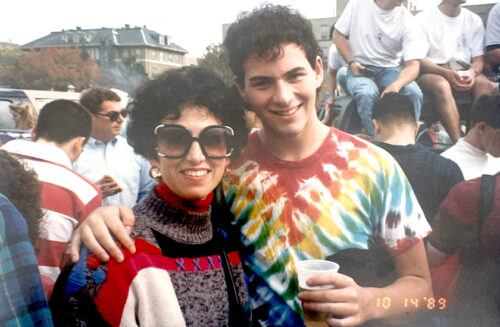
At Cornell, David majored in government, and he loved his classes (with the exception of one physics class, he admits). He attended the Cornell in Washington program in fall of his junior year and landed an internship at the Office of Economic Analysis at the SEC (U.S. Securities and Exchange Commission).
This internship was another pivotal moment for David, helping him home in on the kind of work he liked doing. He realized he wanted to be an economist.
“The internship was only two or three days a week, so I put serious time into my thesis on the regulation of the airline industry, particularly mergers and competition. Professor Alfred Kahn, who was instrumental in the deregulation of the U.S. airline industry, gave it a good read,” David says. “This thesis won me Summa Cum Laude in the Government Department at Cornell.”
David’s internship gave him real-world experience and helped him appreciate the value of this kind of learning. In his philanthropy, David’s goal is to make opportunities like this available to more Cornell students.
The goal: Every student participates in community-engaged learning that matches their studies and interests.
At Cornell, the community-engaged learning that students do may look very different, but their experiences have some important things in common:
- Partnership with organizations to address a specific community interest
- Cornell faculty involvement to integrate experiences with educational content
- Student investment in working with and learning from partners
- Structured critical reflection
According to staff at the Einhorn Center for Community Engagement, the university is on track to reach its goal of 100% participation among undergraduates by 2029.
“The Einhorn Center has continued to advance Cornell’s founding promise to ‘do the greatest good’ by expanding opportunities for students, faculty, staff, alumni, and community partners to work together. What was once an experience for a select few is now a defining feature of a Cornell education.” —Basil Safi MEng ’24, executive director, Einhorn Center
Participation in community-engaged learning has risen from 15% of the Class of 2016 to 87% of the Class of 2026. This means the vast majority of Cornell undergrads are now taking community-engaged courses, participating in engaged research, and/or working with community partners.
Cornell has famously few universal requirements (the swim test being a notable exception). David is keenly aware of the importance of individual choice. Students are choosing to engage, each in their own way. This makes the growth of the initiative over the past decade that much more impressive. It’s a culture shift.
The outcome: It’s a win-win-win for students, faculty, and communities.
David shares another powerful part of his own Cornell experience. During his senior year, he volunteered as a Big Brother for a kid who lived downtown.
“We threw the ball around, and we went ice skating, swimming, and bowling. We hung out with my friends. We made nachos with Doritos, melted cheese, and hot sauce. He loved nachos. Mostly, we just talked,” David recalls.
“I probably saw him 15 or 20 times over the course of the year. I have no idea what happened to him after my senior year ended and the program wrapped up. But his mom always seemed genuinely appreciative that someone showed up for her son.”
This experience reminded David that interacting with people outside the academic bubble matters. It underscored the value of connecting with people across differences.
David says that when making investment decisions, he likes to consider different perspectives. Similar to a debate, he listens to those who believe the stock price will fall and those who think the price will rise. Then he carefully considers both sides and decides whether to buy or sell.
The ability to respectfully listen to other viewpoints deeply matters to him and underlies the work undertaken by the Einhorn Collaborative. According to the foundation’s website, it aims to address “America’s growing crisis of distrust and division.”
David hopes his philanthropy will empower current and future Cornellians with this same superpower.
“When we help students engage openly and respectfully with others through an experience like community-engaged learning, they develop a deeper understanding of different viewpoints, values, and beliefs. They show up with more curiosity and less certainty,” he says.