In October, Mui Ho ’62, BArch ’66 was honored in the space which bears her name—the Mui Ho Fine Arts Library in the Cornell University College of Architecture, Art, and Planning (AAP). The library is just one of the spaces at Cornell that carry the Ho name. Others include Ho Plaza, the central gathering space on the Ithaca campus, which was named in honor of Mui’s family in 1995.
Another is the Cornell Mui Ho Center for Cities, established in 2022 through a foundational gift from Mui. The center is an interdisciplinary hub within AAP that is working to address the complex challenges facing cities around the world—from climate adaptation to access to clean air and water. It is supported by a team of dedicated core and affiliated faculty and staff who, like Mui, are deeply committed to its mission and to the student experience in AAP.
“Mui’s extraordinary ability to make meaningful impact stems from the fearless way she lives her values,” said J. Meejin Yoon BArch ’95, the Gale and Ira Drukier Dean of the College of Architecture, Art, and Planning, at the award ceremony to honor Mui. “Her unwavering commitment to bringing people and ideas together to improve lives runs through her architectural practice, her 33-year career as an educator at Berkeley, and her invaluable contributions to our college, which will benefit our community for generations to come.”
The Ratan N. Tata AAP Distinguished Alumni Award was established in 2024, to celebrate Ratan Tata ’59, BArch ’62 and his legacy of leadership, philanthropy, and service. The award honors AAP alumni who use their Cornell education to do the work Ratan valued: “to build and create good in the world.” Ratan, who died in October 2024, was the award’s inaugural recipient. Mui is the second recipient.
“None of this would be possible without Mui”
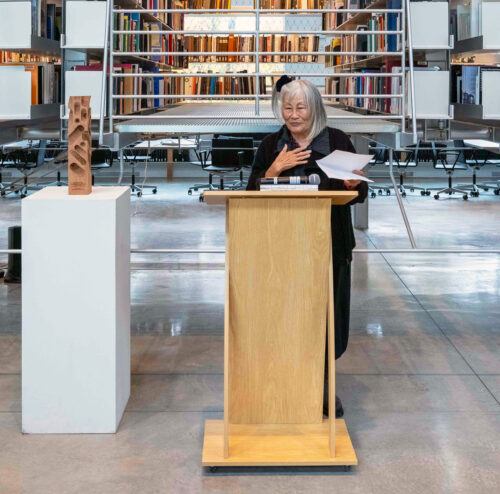
Victoria Beard, director of the Cornell Mui Ho Center for Cities and professor of city and regional planning, spoke about the impact of the center’s work at the October 16 award ceremony at AAP. The following excerpt of Victoria’s remarks provides a sense of the significant legacy Mui Ho leaves to current and future Cornellians.
“The mission of the Cornell Mui Ho Center for Cities is to turn knowledge into action to build more equitable and sustainable cities. The Center is founded on the premise that cities are central to some of the most significant challenges of this century. Inequality is rising around the world, and here in the United States we have the highest income inequality of any of the world’s largest advanced economies. At the same time, our built environment was not designed for the climate, social, and economic challenges we face today. In cities, these forces come together: climate hazards and rising inequality reinforce each other. That is why the Center has two major initiatives.
The first of these is our work on climate adaptation in New York City. This initiative has focused on flooding and extreme heat, and on how vulnerable communities are able to respond to these hazards. This work has been supported by the National Science Foundation, and the Center collaborates with numerous public agencies and environmental justice organizations across the city. The Center organized a Climate Resilience Symposium in New York City that convened 275 urban practitioners. The initiative also supports student field trips and internships. In this work, the Center takes the approach that urban climate adaptation is not only a built environment challenge, but also a question: who is vulnerable, and who is protected?
Our second initiative focuses on building more just and equal cities. To date, this work has centered on informal settlement upgrading in African cities. Informal settlements are neighborhoods where residents lack quality housing and access to basic urban infrastructure. Our partner in this work is Slum Dwellers International, or SDI, a nonprofit that works alongside informal settlement residents in 22 countries across Africa. SDI has been doing this work for more than thirty years, and it hosts our students for ten-week internships in Nairobi, Accra, and Harare. After working side by side with our partners and community members, our students return to Cornell with a very different understanding of the challenges and potential of architecture and urban planning.
None of this work would be possible without Mui. There is no Center for Cities without Mui Ho.
The problems of cities are ‘wicked’ and complex, and they need minds like Mui’s, marked by curiosity, creativity, and a commitment to turning knowledge into action. It is an honor that the Center bears the name of someone whose life and work embodies these values. And, it is fitting that we recognize Mui Ho today with the Ratan N. Tata Distinguished Alumni Award.”
—Victoria Beard, director of the Mui Ho Center for Cities